Effective Lower Back Exercises for the Bed and the Floor
I’m not a physiotherapist. I sit for work - laptop on a stand, external keyboard, the usual desk setup. My back gets stiff after long WordPress build weeks where I skip lunch breaks and barely stand up between commits. For a while Stuart McGill’s Big Three lived in a phone folder next to the kitchen charger. Bookmarked. Respected. Glad I found it - not a daily habit.
Then I built two routines around the same spine-safe idea: Core Bed 3 for mornings when I will not get on the floor, and Core Floor 3 for the next level when I have mat space. Same five to ten minutes. No gym. Easier cues on tired evenings. Glad I stopped treating “clinical and correct” as the same thing as “something I’ll actually do.”
Not medical advice. If you’re injured, see a professional. This is what I run on stiff days now - and when McGill still wins.
Three routines, one spine-safe idea
| Routine | Where | Best for |
|---|---|---|
| McGill Big 3 | Floor | Chronic low back pain, flare-up weeks, spinal endurance |
| Core Bed 3 | Bed | Beginners, busy mornings, building the habit before you have floor space |
| Core Floor 3 | Floor | Healthy adults, hip strength, the routine I default to after desk days |
McGill teaches you to protect your spine. Core Floor 3 teaches you to control and strengthen your body. Core Bed 3 teaches you to move every day - even half-awake, even when the floor is covered in laundry.
McGill Big 3 - when the spine needs the protocol
McGill’s trio - modified curl-up, side plank, bird dog - trains spinal endurance and bracing without grinding your spine through crunch reps. Strong evidence for chronic nonspecific low back pain. Low equipment. Low risk when form is honest.
I needed that lesson. Years of sit-ups and ab-wheel clips left my lower back worse, not better. McGill fixed my mental model: stabilize, don’t flex for reps.
What McGill did not fix was adherence on normal weeks. The curl-up is easy to turn back into a crunch. Bird dog takes coordination I rush when the commit queue is still open in my head. I keep McGill for flare-up weeks. It is the “be careful” folder, not the default.
Modified curl-up
Lie on your back with one knee bent and one leg straight. Hands under your low back to keep a neutral arch. Brace your abs, lift your head and shoulders only a few inches - movement in the upper back, not a full sit-up. Hold with controlled breathing. Switch which leg is bent each set.
Modified curl-up demo - tiny lift, neutral low back, not a crunch.
Side plank (McGill side bridge)
Forearm under shoulder, body in a straight line. Knees down if the full plank turns into a banana. McGill’s version often stacks feet or staggers them - pick the base you can hold ten seconds with honest form.
McGill side plank demo - hips forward, line from head to knees or feet.
Bird dog
On all fours, wrists under shoulders, knees under hips. Brace, extend opposite arm and leg slowly, hips level, back neutral. Hold, return with control. Think “reach long” - not “kick high.”
Bird dog demo - neutral spine, slow reach, no hip twist.
Core Bed 3 - the habit you can run before coffee
The bed changes the training environment. You lose some resistance from a stable floor, so the best bed moves are controlled activation - deep core, hip stability, mobility you can do still groggy.
Core Bed 3 is not a copy of McGill with softer pillows. It is a different trio built for consistency: dead bug, bridge hold, side-lying leg raise. No setup. No clearing floor space. I can run this immediately after waking.
Dead bug
Same move as floor - arms up, knees at ninety, low back gently pressed down. Extend opposite arm and leg slowly. Smaller reach beats a dramatic kick.
On a mattress the cue matters more: don’t let your back arch off the bed. The soft surface forgives cheating.
Dead bug demo - low back stays flat, not how far the leg reaches.
Bridge hold
Lie on your back, knees bent, feet flat. Flatten your low back, squeeze your glutes, lift hips to a straight line shoulder-knee-hip. Hold - thirty seconds if you can, shorter if you cannot keep glutes on and low back out of the lift.
WashU’s demo literally says floor or bed. That is why this lives in Core Bed 3.
Bridge hold demo - glutes lift, low back does not take over.
Side-lying leg raise
Lie on your side, hips stacked, bottom leg bent for balance. Lift the top leg with control - lead with the heel, toes forward, no rocking backward. Fifteen slow reps each side beats thirty sloppy ones.
This is where Core Bed 3 beats McGill for hip contribution. Many desk-back problems are weak glutes and poor hip control, not just weak abs.
Side-lying leg raise demo - hips stacked, slow lift, feel the side of the hip.
How I run Core Bed 3
| Exercise | Reps / time |
|---|---|
| Dead bug | 10 each side |
| Bridge hold | 30 sec × 2 |
| Side-lying leg raise | 15 each side |
Daily if possible. Five minutes. Optional finishers when I have time: knee-to-chest stretch thirty seconds, thoracic rotation ten each side. Not heroics - show up.
Core Floor 3 - what I run after a desk day
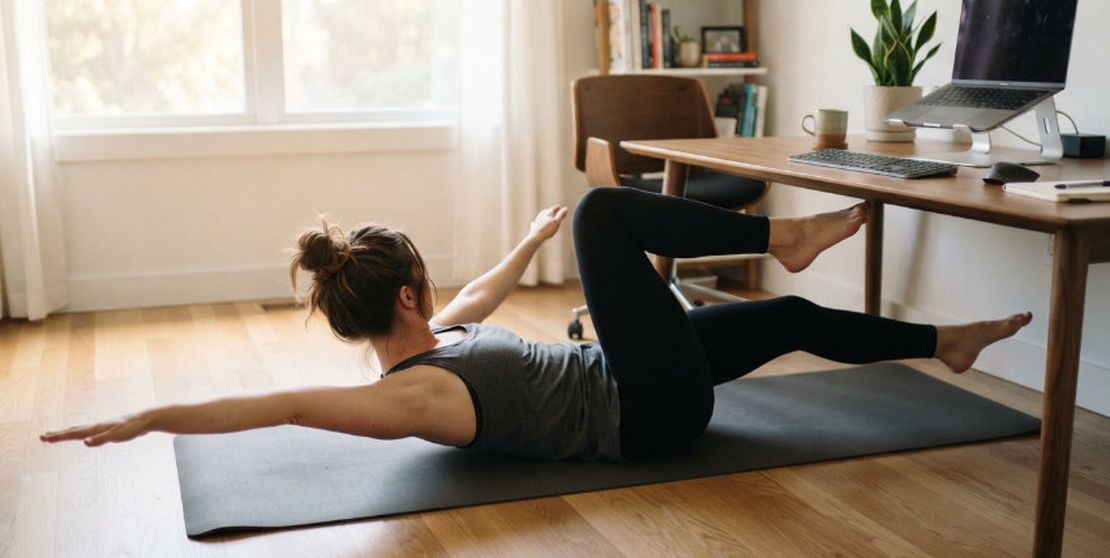
Core Floor 3 is the next level: dead bug, side plank, glute bridge. Side plank stays from McGill. Dead bug replaces bird dog - easier coordination, same anti-extension lesson. Glute bridge adds hip strength long sitting starves.
This is my default floor routine when I am not in a flare-up week.
Dead bug
Lie on your back, arms toward the ceiling, knees bent at ninety degrees. Press your low back gently into the floor. Extend opposite arm and leg slowly - only as far as you can without your back arching. Return. Switch sides.
My first dead bugs were bird dogs lying down - leg shooting out, back lifting, breath held. The cue that fixed it: low back stays glued to the floor.
Dead bug demo - same move as bed; floor gives clearer feedback.
Side plank
Forearm on the floor, body in a straight line. Knees down if the full plank turns into a banana. Ten to twenty seconds done well beats a saggy minute.
I failed this one on pride first. Chased a minute each side. Hips drooped by twenty seconds. Reset: shorter holds, hips forward, neck neutral. Stop when the line breaks.
Side plank demo - watch the hips. That’s where I cheat.
Glute bridge
Lie on your back, knees bent, feet flat. Drive through your heels, squeeze your glutes, lift hips until shoulders-knees-hips make a line. Pause at the top. Lower with control. Don’t hyperextend - you’re building support, not auditioning for a backbend.
I skipped bridges for years because they looked too easy. That was the point. After a week of honest reps, standing up from my desk chair felt less like unfolding a lawn chair.
Glute bridge demo - pelvic tilt first, glutes do the lift.
How I run Core Floor 3
Two or three rounds. Boring on purpose.
| Exercise | Reps / time |
|---|---|
| Dead bug | 6-10 each side |
| Side plank | 10-20 sec each side |
| Glute bridge | 10-15 |
Most weekdays, or a micro-session when I’ve been desk-bound. Exhale on the effort. I still hold my breath on side plank like I’m deadlifting a car. Weekly reset.
Compare the three
| Category | McGill Big 3 | Core Bed 3 | Core Floor 3 |
|---|---|---|---|
| Main purpose | Spine protection and endurance | Daily movement maintenance | General core + hip strength |
| Best for | Back pain, spine rehab | Beginners, busy people, habit building | Healthy adults, prevention, strength |
| Exercises | Curl-up, side plank, bird dog | Dead bug, bridge hold, side leg raise | Dead bug, side plank, glute bridge |
| Learning difficulty | Moderate | Easiest | Moderate |
| After waking, no setup | No | Yes | Sometimes |
| Requires floor space | Yes | No | Yes |
| Core stability | Highest | Good | Highest |
| Hip / glute strength | Light | Strong | Strongest |
| Mobility benefit | Low | Good | Moderate |
| Back-pain evidence | Strongest | Moderate | Good |
| Long-term adherence | I bookmarked it | Easiest to sustain | What I actually run |
Which wins by goal
| Goal | Best pick |
|---|---|
| Existing low back pain | McGill Big 3 |
| Preventing future back problems | Core Floor 3 |
| Getting stronger overall | Core Floor 3 |
| A routine you will do every day | Core Bed 3 |
| Busy parent / office worker | Core Bed 3 → Core Floor 3 |
| Older adult maintaining movement | Core Floor 3 |
| Athlete performance | Core Floor 3 + full-body training |
The honest trade: McGill optimizes for a fragile spine under a researcher’s protocol. Core Floor 3 optimizes for a routine a tired developer will repeat. Core Bed 3 optimizes for the days you would otherwise skip entirely. A habit you do beats a perfect circuit you bookmark.
Progression I actually use
Stage 1 - build the habit: Core Bed 3, daily, five minutes. No negotiation about floor space.
Stage 2 - build capacity: Core Floor 3, three to five times per week.
Stage 3 - add real-world strength: Core Floor 3 plus squats, push-ups, rows, carries.
When I reach for McGill instead: back feels specifically fragile, not just stiff from sitting. Flare-up weeks. Curl-up and bird dog go back in the rotation because McGill built them for that lane.
I keep all three demo sets on the phone now. Core Bed 3 is the morning folder. Core Floor 3 is the default after work. McGill is the “be careful” folder. Either beats another afternoon pretending the desk hunch is fine.
Low back care doesn’t need fancy equipment. Pick the trio you’ll run - bed, floor, or McGill when the spine asks for it. Form over ego, short holds over saggy minutes, hips included.
Glad McGill taught me what crunches were doing wrong. Glad Core Bed 3 is what I can do before the coffee finishes. Glad Core Floor 3 is the circuit I actually open before I sit down again.
Share