The thing I reach for most from my laptop bag isn’t a dongle or a power bank. It’s a short extension cord - glad I finally stopped treating it as optional.
Sounds ridiculous until you’re in a hotel room where the only outlet is behind the bed, across the room from the desk. Or an internet café where someone’s huge Apple charger blocks the socket beside it - looks open from across the room, won’t take your plug. Or a meeting room where the power strip is full and your charger cable is half a metre too short.
I started packing one after one too many calls on a dying battery with nowhere to plug in. Now it lives in the bag as fixed as the laptop itself.
Length: About 2 Metres, Not Five
For laptop duty you want 1.5 to 2 metres. That’s enough to bridge a bad outlet. It’s short enough to coil without turning your bag into a cable nest.
Half a metre short is useless. Five metres is a trip wire in a hotel room and a tangled mess every time you unpack.
I measure once: from the typical bad outlet to where I’d actually sit. Then I add a little slack. For the bag, shorter wins. For a home desk where the wall socket sits in an awkward spot, 3 metres is the longest I’d bother with.
Wire Thickness: You Don’t Need Heavy-Duty
A laptop charger pulls a light load - somewhere between a bright desk lamp and a small fan. You are not running a microwave through this cord.
I grabbed the thinnest cheap cord I could find once and it ran warm under nothing but a laptop. Now I check the jacket before anything goes in the bag. If a cord warms up under a normal laptop load, something is wrong: thin wire, a damaged jacket, or too many things chained together. Unplug it and replace it.
Flat Plug, Right-Angle Head
Hotel furniture and café booths love putting outlets behind something. A flat plug that sits flush against the wall fits where a chunky one won’t. A right-angle head helps when the socket faces the wrong way and you can’t push furniture another centimetre.
Small detail. Huge difference when you’re working on a bed or a booth seat and the outlet is literally behind the headboard.
Plain Extension vs. Surge Strip
A surge protector is an extension cord with a fuse against power spikes. For a laptop, monitor, and router at home, I use a rated surge strip at the desk and leave it there.
In the laptop bag, I carry a plain light cord. Less bulk, less weight, and hotel power is usually short-term. If I’m somewhere for weeks and I don’t trust the wiring, I’ll pack a small surge strip instead. That’s a different item.
What I Actually Pack
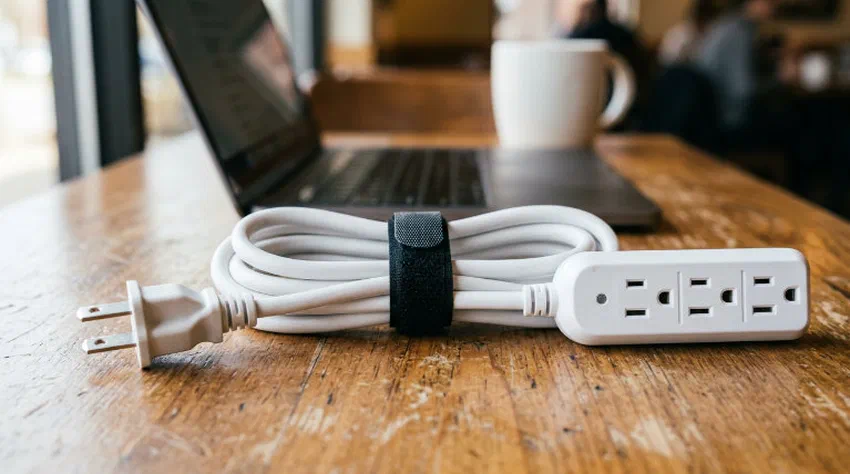
One 2-metre cord with a flat plug lives in the same pouch as the charger. It goes in both my laptop bag and my travel bag. I coil it with a velcro strap. It weighs almost nothing and I’ve lost count of how many dying-battery emergencies it fixed. A dead battery at the wrong outlet kills a meeting, and borrowing someone else’s cord always takes longer than you think.
Safety Habits (Even for a Small Cord)
- Don’t chain extension into extension into power strip - one proper run
- Uncoil it if it’s bundled tight and warm; bundled wire holds heat
- Replace anything with cracked plastic, bent prongs, or a warm smell
- Don’t treat it as a doorstop - foot traffic kills the outer jacket over time
For a laptop, a short extension cord is boring gear that actually gets used. About 2 metres, flat plug, leave it in the bag. Still the first thing I grab when the only outlet is behind the bed - boring gear that earned its keep.
Share