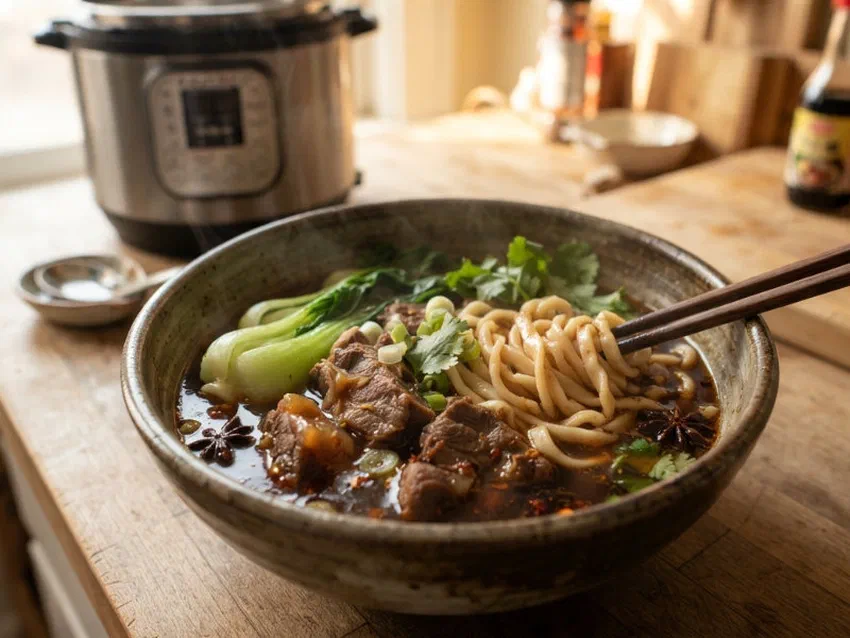
I will detour for ramen, pho, or bun bo hue when someone else is simmering for hours. Same when I am out at a shop that does it right. Glad those bowls exist. I still hate the price. A shop bowl of beef noodle soup costs the same as a kilo of stew beef cubes. That is the part that gets me.
At home I want something close enough. Rich enough to sip, not a packet. No charred bones. No overnight stock. No me standing over a pot for three hours.
Minimum effort. One kilo in. 6-8 bowls out, plus broth for later. The Instant Pot carries the simmer while I am somewhere else.
This is the version I actually make - one 8-quart run. Not a copy of any of the above. No spice paste from scratch either.
I joined my wife at the salon once. A Chinese restaurant next door had beef noodle soup. I ordered a bowl while I waited. Their broth disappointed me. Mine at home tastes better.
Rough-chop yellow onion, tomatoes, and ginger. 1 kg cubed beef from the package.
2.4 L water, 3 beef bouillon cubes, light soy, Worcestershire at the start. No wine. Blanch and brown when I have 10-15 minutes extra.
Dump, stir once, 40 minutes on Meat/Stew. When the timer ends, wait 15 minutes, then vent the rest by hand. Hearty enough to hit the same craving. Lazy enough that I still make it.
Still one rule: noodles stay out of the pressure cooker. Boil them in plain water on the side.
Knife-cut, egg noodles, or whatever wheat noodle you keep around. Same pot rule for all of them.
Noodles in the braise turn to paste. One extra pot. Worth it.
Why This Lazy Batch
Broth-first. I cut beef back to 1 kg and pushed water to 2.4 L (about 10 cups). That is the most I run in an 8-quart with this much meat. I stay under the max-fill line. Less beef per bowl, more soup to ladle. That is the trade I want for noodle soup.
Best flavor upgrade: blanch and brown. The basic recipe is dump-and-go. If you have another 10-15 minutes, blanch and rinse the beef, pat it very dry, then brown it in batches. Wet supermarket cubes steam more than they brown - dry cubes pick up real color. The browned bits add noticeable depth to the broth. Extra pot and skillet. Worth it when I am not rushing.
Blanch is optional. A short boil, then a rinse, knocks the gray foam off the cubes. Cleaner broth. Extra pot. I skip it when I want dump-and-go. The dump-and-go pot still tastes like soup.
Rough chop, not fine dice. Quarter the yellow onion, chunk the tomatoes, slice the ginger thick. Garlic cloves peeled - smash them if you feel like it. No green onion in the pot - yellow onion already carries the allium base. I save green onion for the bowl.
What 40 minutes does to the veg. Tomatoes and garlic mostly melt into the broth - that is where a lot of the body comes from. Onion turns very soft; you may still see pieces when you ladle. Ginger stays fibrous but quiet. This is a broth pot, not a vegetable soup. Strain or ladle carefully if you want a cleaner bowl.
Cubed beef only. Supermarket stew beef - already cubed, usually chuck. Buy a 1 kg package, dump it in, ladle straight into the bowl after pressure. At 40 minutes the cubes are fork-tender - they break apart when you bite, but most pieces still hold shape in the ladle. Not mush. Past 60 minutes on the same cubes they start going stringy and dry. Want more gelatin and a richer broth? Swap part of the stew beef for beef shank. 1 kg chuck from the package is still my default.
One pressure time: 40 minutes. 40 minutes under high pressure is where cubed chuck turns tender and the broth gets body. Collagen work happens there, not on release.
One wait before vent: 15 minutes (timed partial natural release). I do not wait for the pin to drop. That is full natural release - extra minutes, little extra benefit for this soup.
I also do not vent the second the timer beeps. At 2.4 L that loses broth.
Wait 15 minutes with the lid on, then turn the valve and release whatever pressure is left. Same wait every time.
Cube broth, not cartons. I dissolve 3 beef bouillon cubes in the 2.4 L water instead of buying beef stock. Same lazy pantry move as my Instant Pot arroz caldo. Cubes plus soy and Worcestershire carry the savory base - no homemade stock, no overnight simmer.
A 6-quart will not take this much liquid with a full kilo of beef - cut beef, water, and seasoning in half.
1 tsp five-spice. Powder only - no spice bags. 1 tsp in 2.4 L keeps five-spice in the background. Use 1 1/2 tsp only if your blend is mild.
Worcestershire at the start. 1 tbsp goes in with the water and soy - same move as my adobo. Fills the savory gap cube broth leaves without wine.
Doubanjiang - optional upgrade. Skip it and you still get a solid bowl: soy, tomato, five-spice. Add 25 g (about 1-1 1/2 tbsp) when I want fermented chili-bean depth and heat - the Taiwan-inspired bump without a shelf of specialty jars.
Taste after pressure. 90 ml light soy at the start is enough for soy to read clearly without oversalting. After venting, add another 15 ml soy if the broth still tastes flat.
If You Care (Optional)
Default below is weeknight batch - same 40 minutes under pressure. Three escalations if you want more depth without rewriting the recipe:
- Blanch and brown: Best flavor upgrade - see optional steps below. Cleaner broth, real Maillard on dry cubes. 10-15 minutes extra.
- Stock not cubes: Use 2400 ml beef stock (about 10 cups) instead of water; cut to 1-2 beef bouillon cubes or skip them. Same load and pressure time.
- Strain the bowl: Ladle through a fine-mesh strainer, or strain the pot once after venting. Keeps ginger fibers and onion chunks out of the bowl.
My Weeknight 8-Quart Batch
Feeds 6-8 bowls. Broth keeps two days in the fridge; freeze the rest. Boil fresh noodles each time.
Ingredients
Beef and Aromatics (Rough Chop)
- 1000 g cubed beef stew meat, about 2.2 lbs (supermarket stew beef; chuck cubes)
- 400 g yellow onion, about 1 large, peeled, roughly chopped
- 300 g tomatoes, about 3 medium, roughly chopped
- 20 g garlic, about 6 cloves, peeled
- 50 g fresh ginger, about 5 cm (2 inches), roughly sliced
Broth and Seasoning
- 2400 ml water, about 10 cups
- 3 beef bouillon cubes
- 90 ml light soy sauce, about 6 tbsp
- 15 ml Worcestershire sauce, about 1 tbsp
- 12 g brown sugar, about 1 tbsp
- 1 tsp Chinese five-spice powder
Optional: More Depth
- 25 g doubanjiang (spicy bean paste), about 1-1 1/2 tbsp - fermented chili-bean heat
- 15 ml neutral oil, about 1 tbsp (only if you blanch and brown)
Noodles
- 800 g dried noodles, about 4 bundles (about 100-130 g dried per bowl)
- knife-cut, egg noodles, lo mein, or similar wheat noodles (fresh noodles work too; follow package time)
Toppings, Optional
- 450 g baby bok choy, about 4 heads
- 60 g green onion, about 4 stalks, thinly sliced
Notes Before You Start
Dissolve the cubes first. Pour the 2400 ml water, add 3 beef bouillon cubes, and stir until dissolved before the beef goes in. If you use doubanjiang, stir it into that liquid too so nothing thick sits dry on the bottom.
Stay below max-fill. 2.4 L water plus the beef and veg should sit well under the 8-quart max-fill line. Check before you seal the lid.
Start light on soy. 90 ml light soy plus 3 cubes and Worcestershire already stack umami and salt. Taste after venting. Add another 15 ml soy if the broth still tastes flat - easier than fixing oversalted soup.
No wine. Tomatoes, soy, Worcestershire, and the beef itself carry most of the flavor. Taste after venting - see Step 3 if something is off.
Timed partial natural release. Set a timer when HP ends. Do not touch the valve until 15 minutes pass, then release remaining pressure manually. Not full natural release. Not immediate quick release.
Blanch water is trash. If you blanch, discard that water. Do not add it to the Instant Pot. The gray foam is what you were trying to leave behind.
How I Run It
Optional: Blanch the Beef (More Depth)
Place 1000 g cubed beef stew meat (about 2.2 lbs) in a saucepan. Cover with cold water.
Bring to a boil over high heat. Boil until gray foam rises, 2-4 minutes.
Drain. Rinse the cubes under cold water until the water runs clear. Discard the blanch water.
Pat the cubes dry if you are going to brown them. Skip the next optional step if you are not.
Optional: Brown After the Blanch (Best Flavor Upgrade)
Only after the blanch and rinse. Wet cubes will steam.
Heat a skillet over medium-high heat. Add 15 ml neutral oil (about 1 tbsp).
Brown the rinsed, patted-dry cubes in two batches, 2-3 minutes per side, until they pick up color.
Transfer the browned cubes to the Instant Pot.
Add 60 ml water (about 1/4 cup) to the skillet, scrape the browned bits, and pour that liquid into the Instant Pot.
Step 1: Prep and Load the Pot
Roughly chop 400 g yellow onion, peeled (about 1 large) and 300 g tomatoes (about 3 medium). Slice 50 g fresh ginger (about 5 cm / 2 inches). Peel 20 g garlic (about 6 cloves).
Pour 2400 ml water (about 10 cups) into the Instant Pot.
Add 3 beef bouillon cubes, 90 ml light soy sauce (about 6 tbsp), 15 ml Worcestershire sauce (about 1 tbsp), 12 g brown sugar (about 1 tbsp), 1 tsp Chinese five-spice powder, and 25 g doubanjiang (spicy bean paste) (about 1-1 1/2 tbsp), if using. Stir until the cubes dissolve.
Add 1000 g cubed beef stew meat (about 2.2 lbs) unless the cubes are already in the pot from browning. Add the chopped onion and tomatoes, 20 g garlic, peeled (about 6 cloves), and 50 g fresh ginger, roughly sliced (about 5 cm / 2 inches).
Stir once so everything is evenly wet. Do not stir again after the lid goes on.
Step 2: Pressure Cook
Seal the lid.
Cook on:
- High Pressure (Meat/Stew): 40 minutes
- Timed partial natural release: wait 15 minutes with the lid on, then release remaining pressure manually
Do not vent immediately when the timer ends. Do not wait for the float valve to drop on its own.
Step 3: Finish the Broth
Taste the broth before you bowl it. Adjust in small steps - you cannot take soy or salt back out.
| If it tastes… | Try |
|---|---|
| Flat or thin | 15 ml light soy sauce (about 1 tbsp); simmer on Sauté 5-8 minutes uncovered to concentrate |
| Not salty enough | Pinch of kosher salt, then taste again |
| Too salty | Ladle into bowls as-is; dilute leftovers with hot water when you reheat |
| Not beefy enough | Dissolve 1 extra beef bouillon cube in a ladle of hot broth, stir back into the pot |
| Not sweet enough | 5 g brown sugar (about 1 tsp) |
| Missing heat or depth | 15 g doubanjiang (about 1 tbsp) on Sauté, or chili crisp at the bowl |
| Too perfumey (five-spice) | Dilute with 120 ml hot water (about 1/2 cup); note for next time: use 1/2 tsp five-spice |
Strain the broth or ladle carefully if you do not want big veg pieces in the bowl. Leave softened garlic in the pot.
Keep the broth warm on Low Sauté or Warm.
Step 4: Cook the Noodles
Bring a large pot of water to a boil.
Cook 800 g dried noodles (about 4 bundles, about 100-130 g per bowl) until tender - knife-cut, egg noodles, or similar. Follow package time; egg noodles often finish faster than thick knife-cut.
Blanch 450 g baby bok choy (about 4 heads) in the same water for the last 60-90 seconds, if using. Drain.
Step 5: Assemble
Divide noodles among 6-8 bowls.
Add beef and ladle broth over the top until the bowls are full.
Top with bok choy and 60 g green onion, thinly sliced (about 4 stalks), if using.
Leftover Broth Is the Point
2.4 L is more soup than one dinner. That is how a kilo of cubes beats a shop bowl.
Next-day bowls. Broth and beef keep two days in the fridge. Boil fresh noodles each time. I have left noodles sitting in leftover broth. Paste. Same rule as night one.
Freeze the rest. Portion into containers. Later: thaw, boil noodles, ladle. No second 40-minute cook.
Rice. Cook rice in leftover broth instead of water. Eat leftover beef over that rice, or put a smaller noodle bowl next to it.
A mug. Reheat a cup of broth when you do not want a full bowl. That is still the kilo stretching.
Do not pour it out.
Glad the Instant Pot still earns its spot for this one. One kilo of cubes, a shop-bowl problem solved at home, leftover broth in the fridge. Good broth, minimum effort - that is why I keep making it.
Share